Multi-currency
How to transfer money internationally from UAE | costs, rails and the fastest options | Hubpay
UAE businesses lose AED 2-5% on every international transfer through hidden bank markups. Learn how SWIFT, SEPA and Faster Payments work, what it really costs, and how to cut those costs by up to 90%.
10 min read
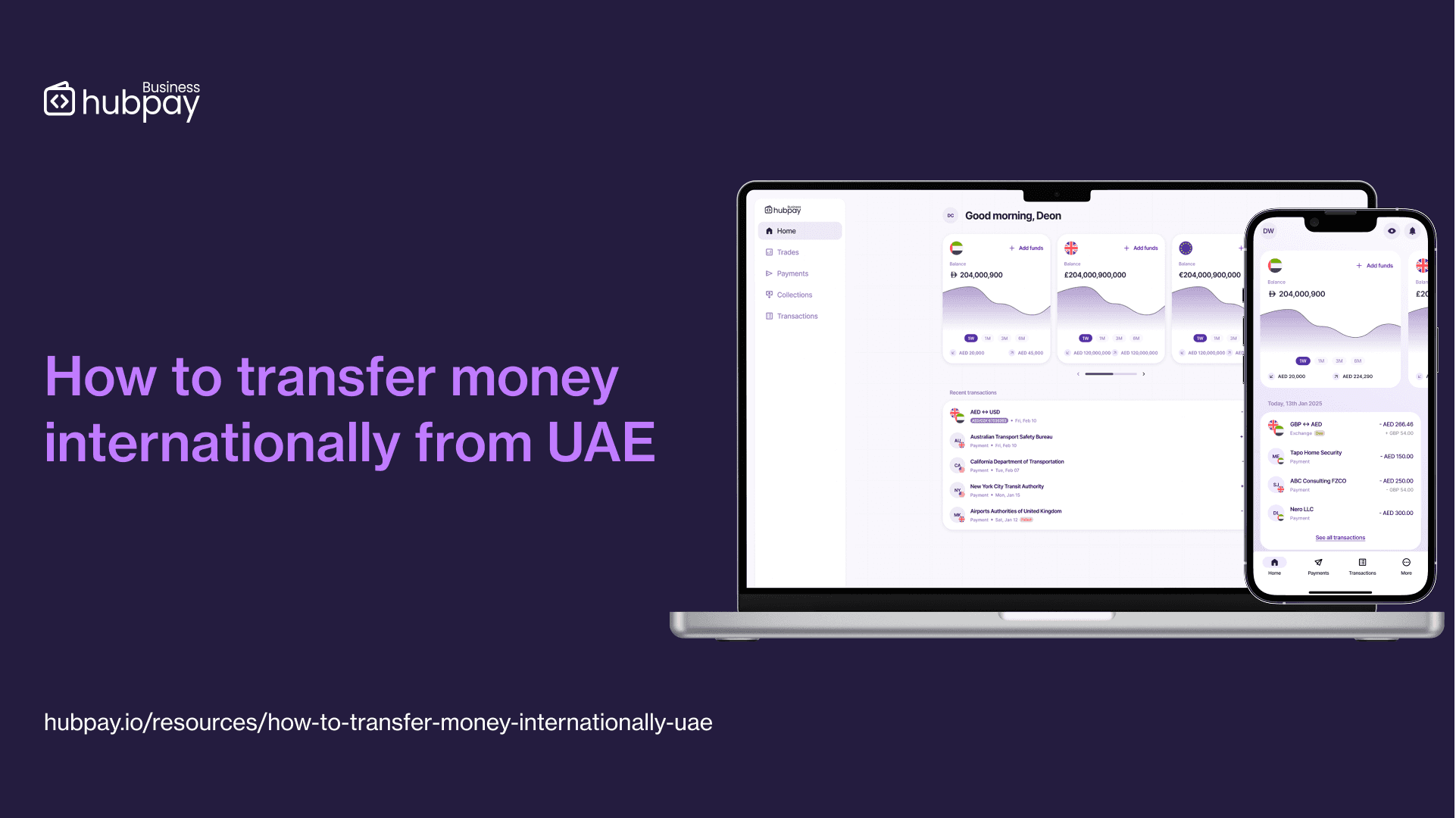
How to transfer money internationally from the UAE
Every international transfer through a traditional UAE provider account costs more than it should most of that cost is hidden inside the exchange rate. Here is how to understand the true cost, choose the right payment rail, and reduce what you pay by up to 90%.
If your UAE business sends money to suppliers in Europe, pays contractors in South Asia, or repatriates' revenue to shareholders overseas, you are almost certainly paying more than you need to. A standard UAE provider international wire involves three compounding costs that are rarely disclosed in one place: a transfer fee, a currency conversion markup embedded in the exchange rate, and correspondent bank charges deducted in transit before the payment arrives.
This guide explains how international transfers from the UAE actually work, which payment rail to use for each destination, what the full cost looks like, and how businesses are reducing those costs by switching to cross-border payment platforms built for the UAE market.
How international money transfers from UAE work
When a UAE business initiates an international transfer through a traditional bank, the payment typically travels via the SWIFT network the global messaging system that banks use to communicate payment instructions. SWIFT does not move money directly. It sends a series of messages between correspondent banks, each of which holds accounts with the next institution in the chain. The actual funds move through a series of nostro and vostro accounts between banks until they reach the destination.
This correspondent banking chain is the root cause of three problems for UAE businesses.
Problem 1: The FX markup is embedded in the rate
UAE providers set their own exchange rate for international transfers. The difference between the interbank mid-market rate, the rate banks use to transact with each other and the rate offered to customers is typically 2-5%. This markup is not displayed as a fee. It is built into the quoted rate, which is why your AED 100,000 wire arrives as EUR 25,200 rather than EUR 26,800. The difference is the bank's margin.
Problem 2: Correspondent bank charges are deducted in transit
Each correspondent bank in the chain may deduct a fee before forwarding the payment. These fees range from USD 10 to USD 50 per institution, and there may be two or three correspondent banks in a single transfer. The sender has no visibility over how much will arrive at the other end until after the fact.
Problem 3: Settlement takes 3-5 business days
SWIFT transfers settle over multiple days because each correspondent bank must process and forward the message during its own business hours. A payment from the UAE to a European supplier initiated on a Thursday may not settle until the following Tuesday after accounting for time zones and weekends creating working capital delays that compound across a full invoice cycle.
What these costs in practice: A UAE business sending AED 500,000 per month to European suppliers via a standard wire loses between AED 10,000 and AED 25,000 per month to the FX markup alone before accounting for transfer fees and correspondent charges. Over a year, that is AED 120,000 to AED 300,000 in preventable costs.
The main payment rails - which one to use for each destination
SWIFT is not the only way to move money internationally. Local payment rails domestic networks that clear payments within a country or currency zone are significantly faster and cheaper than SWIFT for recipients in those markets. The key to reducing international transfer costs is routing payments onto local rails wherever possible, which requires holding balances in the destination currency and having access to local payment infrastructure.
Europe (SEPA) - Single Euro Payments Area covers 36 countries. Transfers between EUR accounts settle within one business day at near-zero cost. Requires a named EUR IBAN to receive payments as a local transfer. Next-day settlement
United Kingdom (Faster Payments) - UK domestic rail for GBP payments. Transfers between GBP accounts settle in seconds, 24 hours a day, 7 days a week. No transfer fee between UK accounts. Requires a named GBP IBAN. Instant - 24/7
United States (ACH) - Automated Clearing House processes USD transfers between US bank accounts. Same-day or next-day settlement depending on submission time. Significantly cheaper than SWIFT. Requires a named USD account with routing number. Same or next day
India (IMPS / UPI) - India's Immediate Payment Service and Unified Payments Interface process INR transfers instantly. UAE-to-India payments can reach local recipients' same day via partner bank networks. Relevant for payroll and vendor payments to India. Instant
Global fallback (SWIFT) - Required for currencies and countries not covered by local rails, or when the recipient does not have a local bank account. Slower (3-5 days) and more expensive due to correspondent bank chain. Use only when no local rail is available. 3-5 business days
Bangladesh · Pakistan · Philippines (Remittance corridors) - High-volume UAE corridors to South Asia and Southeast Asia are served by a combination of partner bank networks, mobile wallet integrations (bKash, JazzCash, GCash), and SWIFT. Settlement times and costs vary significantly by provider. Varies by corridor
The key insight: accessing local payment rails requires a named account in the destination currency. A UAE business with a named GBP IBAN can receive payments from UK clients via Faster Payments for free in seconds. The same business without a GBP IBAN forces every UK client to send an international wire slow, expensive, and a reason for clients to delay payment.
What a UAE international transfer actually costs - the full breakdown
The following illustrates the real cost of a UAE business sending AED 100,000 to a European supplier, comparing a standard UAE transfer with a multi-currency business account using local payment rails.
Cost component | Standard UAE provider | Hubpay multi-currency account |
|---|---|---|
Transfer fee | AED 50-200 per transaction | Included in subscription |
FX conversion markup | 2-5% embedded in rate | Cheaper |
Correspondent bank charges | USD 10-50 deducted in transit | 52.50 AED (Shared), 65 AED (OURS) |
Settlement time | 3-5 business days | Same day (SEPA) or instant (Faster Payments) |
Estimated cost on AED 100,000 | AED 2,050-5,200 | Cheaper |
Cross-border payment solutions for UAE businesses
The shift from SWIFT-only to multi-rail payment infrastructure is the most significant development in international money transfer from the UAE over the past five years. A new category of CBUAE and ADGM-licensed payment providers now offers UAE businesses access to local payment rails in 30+ currencies, without the need to open a physical account in each country.
These platforms work by maintaining their own banking relationships and liquidity in each currency market. When your UAE business sends EUR to a European supplier, the payment routes from your EUR wallet through the provider's SEPA membership arriving the next business day as a local transfer, with no correspondent bank chain and no markup on the mid-market rate beyond a disclosed spread.
What to look for in a cross-border payment provider in UAE
Regulatory status: Confirm the provider holds a valid UAE financial services licence. The two primary regulators are the Central Bank of the UAE (CBUAE) and the Abu Dhabi Global Market's Financial Services Regulatory Authority (FSRA). An unlicensed provider creates compliance exposure and offers no recourse if funds are delayed or frozen.
Named IBANs vs pooled accounts: Some providers assign you a dedicated account number in each currency, a named IBAN issued under your company name. Others pool multiple customers into a shared account number. Named IBANs are preferable because they allow counterparties to identify your payment unambiguously and enable local rail access for incoming transfers.
Transparent FX pricing: Request the all-in spread the difference between the mid-market rate and the rate you receive for the currencies you use most. A provider charging 0.5% on EUR and 0.8% on GBP is more expensive at scale than one charging a flat 0.4% on both, even if the headline transfer fee is lower.
Settlement currency options: If you invoice in EUR but pay suppliers in GBP, a platform that lets you hold both currencies and convert when rates suit you prevents unnecessary double conversion. Look for providers that let you hold multiple currency balances and convert on demand.
FX hedging tools: For businesses with predictable foreign currency exposures EUR supplier contracts, USD payroll commitments, GBP rent forward contracts allow you to lock in an exchange rate for up to 12 months. This removes the risk of a 5-10% adverse rate movement between signing a contract and making the payment.
How Hubpay handles international transfers for UAE businesses
Hubpay is an ADGM-licensed Electronic Money Institution providing international payment infrastructure to UAE-registered businesses, free zone entities, and non-resident companies operating in the UAE.
Multi-currency accounts with named IBANs
Every Hubpay business account includes named virtual IBANs in 30+ currencies AED, USD, EUR, GBP, JPY, AUD, CAD, CHF, SGD, and more. Each IBAN is issued under your company name, not a pooled number. International clients pay you as a local transfer in their own currency. You hold the balance and convert when it suits you. See how named virtual IBANs work.
Local rail access in 150+ currency pairs
Outgoing payments route via SEPA, Faster Payments, ACH, and regional networks where available not SWIFT by default. The result is faster settlement, no correspondent deductions, and a lower all-in cost per transfer.
International payroll in 85+ countries
UAE businesses paying employees, contractors, or vendors overseas can initiate bulk payroll in 85+ countries directly from the Hubpay platform. Upload via CSV or connect via API. Payments route in the recipient's local currency without manual conversion steps.
Forward contracts and FX hedging
Treasury tier clients can lock in exchange rates for up to 12 months in advance using Hubpay's forward contract facility. A 5% deposit secures the rate. Businesses with EUR supplier contracts or GBP payroll commitments use this to eliminate rate volatility from their cost base. Full details on Hubpay's corporate FX services.
Payment links for international collections
UAE businesses that invoice international clients can also use Hubpay payment links to accept Visa, Mastercard, Apple Pay, and Google Pay from overseas buyers reducing the DSO on international receivables without requiring the client to initiate a wire transfer.
How to transfer money internationally from UAE - step by step
Choose the right payment rail for your destination - Check whether your destination currency has a local rail available. EUR to Europe means SEPA. GBP to UK means Faster Payments. USD to US clients means ACH. Using local rails saves on the FX conversion and eliminates correspondent bank fees.
Open a multi-currency account with named IBANs - Access to local payment rails requires holding balances in the destination currency. Apply for a Hubpay business account at hubpay.io/pricing. Account activation takes 24-48 hours from document submission. Named IBANs in your selected currencies are issued simultaneously.
Collect incoming payments in the original currency - Share your named IBAN with your clients and ask them to pay in their local currency. A UK client paying your GBP IBAN via Faster Payments pays nothing to send and you receive in seconds. The funds sit in your GBP wallet, no forced conversion on receipt.
Match receivables with payables to eliminate unnecessary conversions - If you receive EUR from European clients and pay EUR to European suppliers, route the funds directly without converting to AED first. Natural hedging within the platform removes the double-conversion cost that most UAE businesses pay without realizing it.
Lock in rates for predictable future payments with forward contracts - For contracts signed in a foreign currency supplier agreement, employment contracts, lease commitments use a forward contract to fix the exchange rate for up to 12 months. A 5% deposit secures the rate on Scale and Treasury tier accounts.
Convert remaining balances when rates are favorable - For currencies you hold but need to convert to AED profit repatriation, salary drawdown set a target rate using Hubpay's market order facility. The conversion executes automatically when the market hits your target, removing the need to monitor rates manually.
Frequently asked questions
How do I transfer money internationally from the UAE?
To transfer money internationally from the UAE, you need a business account with international transfer capabilities. Through a traditional UAE provider, you initiate a SWIFT wire transfer by providing the recipient's bank account details, IBAN, and SWIFT/BIC code. Through a multi-currency platform like Hubpay, you can transfer directly from currency-specific wallets via local payment rails SEPA for Europe, Faster Payments for UK, ACH for US which is faster and cheaper. The transfer initiates from your dashboard; no branch visit is required. Full details at hubpay.io/multi-currency-account.
What is the cheapest way to transfer money internationally from UAE?
The cheapest way to transfer money internationally from the UAE is to use local payment rails rather than SWIFT. Holding balances in EUR, GBP, or USD via a multi-currency account allows you to pay via SEPA, Faster Payments, or ACH domestic networks with near-zero transfer costs and no correspondent charges. The FX conversion spread matters most at volume.
How long does an international transfer from UAE take?
An international transfer from the UAE via SWIFT typically takes 3-5 business days, depending on the destination country, the correspondent banking chain, and time zone differences. Transfers via local payment rails are much faster: SEPA (Europe) settles the next business day; Faster Payments (UK) settles in seconds 24/7; ACH (US) settles same or next day. The settlement time depends entirely on the payment rail used, not the amount being transferred.
What is the difference between SWIFT and SEPA for UAE businesses?
SWIFT is a global messaging network used for international transfers between banks in different countries. It routes payments through a chain of correspondent banks, each of which may charge fees and take time to process the payment. SEPA is a regional payment network for EUR transfers within 36 European countries. SEPA transfers settle within one business day at minimal cost because they use local infrastructure rather than correspondent banking chains. A UAE business with a named EUR IBAN can send and receive via SEPA, bypassing SWIFT entirely for European EUR payments.
What documents do I need to send an international transfer from UAE?
To send an international transfer from a UAE business account, you typically need the recipient's full name or company name, their bank account number or IBAN, their bank's SWIFT/BIC code, the bank name and address, and the purpose of the transfer (required by UAE AML regulations). For transfers above certain thresholds, your provider may also require a copy of the supporting invoice or contract. Through Hubpay, most of this information is saved once and reused for repeat payments to the same beneficiary.
Open a free multi currency account with Hubpay
We help companies all around the globe to send money in the easiest and cheapest way using multiple currencies. Talk to Hubpay Corporate FX team today
Share this blog on