How UAE businesses can collect payments from Africa in NGN, GHS, KES and more
UAE businesses trading with Africa can now collect payments in NGN, GHS, KES, XAF, XOF and MZN through dedicated collection accounts. Settle in AED, accept card payments via payment links, and open your account in 24-48 hours.
10 read

How UAE businesses can collect payments from Africa in NGN, GHS, KES and more
UAE-Africa non-oil trade crossed $112 billion in 2024, a 34% year-on-year surge that made it one of the fastest-growing bilateral trade corridors in the world. Over 26,900 African companies are now active members of Dubai Chamber of Commerce. The UAE has signed comprehensive trade agreements with Nigeria, Kenya, Mauritius, and three other African nations since 2024 alone.
Yet for most UAE businesses operating in this corridor, one problem persists: getting paid. Collecting payments from clients in Nigeria, Ghana, Kenya, Cameroon, Senegal, or Mozambique still means navigating slow bank wires, unfavorable FX conversions, and infrastructure that was not built for African currencies. The average cost of cross-border payments into Sub-Saharan Africa sits at 8.78% per transaction, well above the global average of 6.49% and more than double the G20 target of 3%.
This guide explains how UAE businesses in technology, IT services, consulting, and agriculture can collect payments from Africa efficiently, settle in AED, and remove the friction that is currently costing them both time and margin.
The UAE-Africa trade boom: What the numbers show
The scale of the opportunity is no longer speculative. Here are three data points every UAE business trading with Africa should know.
$112 billion in non-oil trade in 2024. UAE-Africa bilateral trade grew 34% year on year, outpacing UAE global trade growth of 14.6% by more than double. Sub-Saharan Africa alone saw an 87% surge in trade with the UAE over the past five years, from AED 126.7 billion in 2019 to AED 235 billion in 2024. (Source: UAE Ministry of Foreign Trade / WAM)
6 CEPAs signed with African nations since 2024. The UAE signed Comprehensive Economic Partnership Agreements with Nigeria (January 2026), Kenya (January 2025), Mauritius, Republic of Congo, Angola, and Sierra Leone, eliminating tariffs on thousands of products and creating predictable frameworks for cross-border trade. (Source: UAE Ministry of Economy)
26,900+ African companies trading through Dubai. Africa now accounts for 9.7% of all Dubai Chamber member exports and re-exports, valued at AED 16.7 billion in H1 2025 alone, making it the third-largest destination region behind the GCC and wider Middle East. (Source: Dubai Chambers, 2025)
Why collecting payments from Africa is still a challenge for UAE businesses?
Trade volumes are growing. Payment infrastructure is not keeping up. UAE businesses typically encounter three compounding problems when trying to collect from African clients.
1. No collection account in local African currencies
Most UAE business accounts are structured for AED, USD, EUR, or GBP. Asking an African client to convert NGN, GHS, or KES into USD before wiring across creates friction on their end, introduces FX loss on both sides, and adds 3-7 business days to every transaction. The client pays more. You receive less. Settlement is slow.
2. High FX markups on African currency conversions
Traditional channels apply FX markups of 2-5% on currency conversions between African currencies and AED. On a $100,000 contract, that is between $2,000 and $5,000 lost before the money reaches your account. Transparent FX pricing with competitive spreads is not a standard feature of most UAE business banking arrangements.
3. No card payment option for African clients
Many African businesses and professionals prefer or require card-based payment options, particularly in markets like Nigeria and Ghana where card infrastructure is mature. Without a payment link solution, UAE businesses invoice by email and chase by WhatsApp, extending collection cycles by weeks.
The African currencies UAE businesses need to collect in
Below is a breakdown of the five currency corridors most relevant to UAE businesses trading with Africa.
Nigerian naira (NGN): the largest African corridor
UAE-Nigeria non-oil bilateral trade reached $4.3 billion in 2024, a 55.3% year-on-year increase, making Nigeria the UAE's largest African trade partner by volume. The January 2026 CEPA eliminates tariffs on 7,315 Nigerian products. Nigeria's technology sector is growing rapidly, with over $700 million raised by African fintech startups in 2025, a significant portion of which flows through Lagos. UAE businesses providing IT services, consulting, and enterprise software to Nigerian clients face NGN collection as their primary payment challenge.
Ghanaian cedi (GHS): fast-growing and tech-forward
Bilateral UAE-Ghana trade stood at $3.91 billion in 2023, and the UAE emerged as Ghana's top export destination in Q4 2024, absorbing 23.3% of total Ghanaian exports. Ghana's mobile money ecosystem processed GHS 3.02 trillion in 2024, and remittance inflows surged 91% to $4.6 billion, reflecting the depth of financial activity in the market. A UAE-backed $1 billion innovation and AI hub was announced at Ningo-Pram pram in late 2025, signaling the direction of UAE-Ghana digital investment. GHS collection is becoming a priority for UAE consultants and technology firms servicing Accra-based clients.
Kenyan shilling (KES): the East African gateway
UAE-Kenya non-oil trade reached $3.1 billion in the first nine months of 2024, up 29.1% year on year. The UAE-Kenya CEPA, signed in January 2025, covers 14 sectors including digital trade, services, and investment, and Abu Dhabi sovereign fund ADQ committed a $500 million investment framework to Kenya shortly after. G42 and Microsoft jointly committed $1 billion to a geothermal-powered data center in Nairobi. Kenyan professional services clients, aggrotech companies, and logistics operators are an active source of demand for UAE-based consultants and software providers. KES collection into an AED account, without routing through USD intermediaries, is the solution these businesses need.
West African CFA franc (XAF and XOF): the francophone corridor
UAE-Cameroon non-oil trade reached $1.24 billion in 2024, a 116% increase from 2022. UAE Trade Minister Dr. Thani Al Zeyoudi led a high-level delegation to Yaounde in January 2026 for a UAE-Cameroon Trade and Investment Day. UAE-Senegal bilateral trade was approximately $1.04 billion in 2023, with active negotiations towards a CEPA underway. Across the CFA franc zone, which includes Cameroon, Senegal, Ivory Coast, Gabon, Niger, and Togo, UAE businesses in agriculture, consulting, and digital infrastructure are increasingly active. XAF and XOF collection are the relevant currency needs for this corridor.
Mozambican metical (MZN): Southern Africa's rising market
UAE-Mozambique bilateral trade reached $1.3 billion in 2022, growing from $550 million in 2018. Over $3 billion in UAE FDI has flowed to Mozambique since 2014, spanning transport, logistics, energy, and services. DP World's $165 million Maputo Port expansion and AMEA Power's $150 million solar project are among the flagship investments. UAE businesses providing services to Mozambican project operators, local firms, or government entities need MZN collection as a practical settlement option.
How UAE businesses collect payments from Africa with Hubpay
Hubpay is an ADGM-licensed payment infrastructure provider built for UAE businesses with cross-border payment needs. Here is how the two core collection methods work for African payments.
Dedicated collection accounts in African currencies:
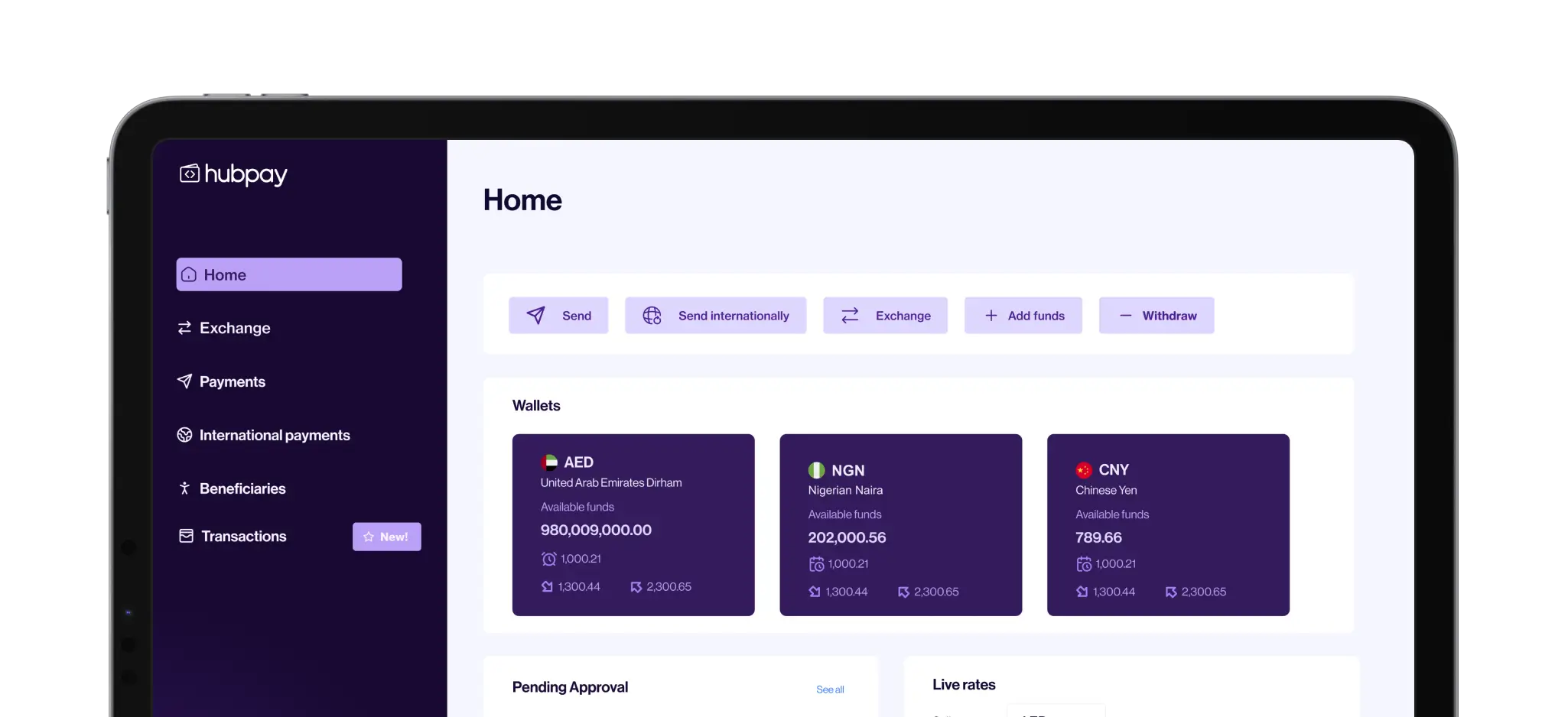
Instead of asking African clients to convert currency before sending, Hubpay provides dedicated collection accounts in NGN, GHS, KES, XAF, XOF, MZN and more. Your client pays in their local currency. Funds are received into your collection account and settled directly into your Hubpay AED account at transparent FX rates, with no hidden conversion fees and no minimum balance requirement.
This eliminates double conversion, reduces the FX cost your client absorbs, and gives you a single AED balance across all African payment corridors. For businesses doing recurring collections from African clients, this is the most efficient structure available in the UAE today.
Payment links for instant card collection:
For one-off invoices, project milestones, or retainers, Hubpay's payment link solution lets UAE businesses share a link by email or WhatsApp and accept payment by debit or credit card from clients anywhere in Africa. Transactions are processed at 2.49% + AED 1 per card transaction, and Hubpay clients typically see faster collection cycles compared to traditional invoice-and-wire workflows.
This is particularly relevant for clients in Nigeria, Ghana, and Kenya where card penetration is high and clients expect a digital payment experience rather than a bank transfer request.
Which UAE industries benefit most from African payment collection?
Technology and IT services:
UAE-based software companies, SaaS providers, IT consultancies, and managed service providers with African clients face the payment collection challenge most acutely. Project fees, software licences, and support retainers all need to be collected in local African currencies and converted to AED efficiently. With Nigerian tech investment surging and Kenyan and Ghanaian digital economies expanding rapidly, the client base for UAE technology firms across Africa is growing faster than the payment infrastructure serving it.
Consulting and professional services:
Management consultants, HR firms, legal advisers, and financial professionals working with African clients need flexible collection structures. Engagements are often milestone-based, making payment links ideal for project sign-off moments. Ongoing retainers suit the collection account model, where regular transfers from African clients settle automatically into AED without requiring manual FX conversion each time.
Agriculture and aggrotech:
The UAE's food security strategy has driven significant agricultural investment across Africa. UAE aggrotech companies, input suppliers, and commodity traders working with African partners, cooperatives, and offtakes need AED settlement from NGN, XOF, KES, and MZN-denominated contracts. Collection accounts that support these currencies remove a structural barrier to scaling African agribusiness operations from a UAE base.
As UAE-Africa trade continues its structural growth, payment infrastructure will determine which businesses capture the opportunity and which leave revenue on the table. Hubpay provides the collection accounts, FX settlement, and payment link infrastructure to ensure your business is on the right side of that divide.
Open your Hubpay business account in 24-48 hours or book a free demo with our team to see how African payment collection works in practice.
Frequently asked questions
Can UAE businesses open a collection account in Nigerian naira (NGN)?
Yes. Through Hubpay, UAE businesses can access dedicated collection accounts in NGN and other African currencies including GHS, KES, XAF, XOF, and MZN. Funds collected from African clients settle into your Hubpay AED account at transparent FX rates with no hidden fees.
How long does it take to receive a payment from Africa into a UAE account?
With traditional bank wires, UAE businesses typically wait 3-7 business days for payments from African markets to clear. With Hubpay collection accounts, the settlement timeline is significantly faster as funds are received into local-currency collection accounts and converted directly to AED.
Which African countries can UAE businesses collect payments from through Hubpay?
Hubpay supports collections from Nigeria (NGN), Ghana (GHS), Kenya (KES), Cameroon and the Central African franc zone (XAF), Senegal, Ivory Coast and the West African franc zone (XOF), Mozambique (MZN), and more.
Open a free multi currency account with Hubpay
We help companies all around the globe to send money in the easiest and cheapest way using multiple currencies. Talk to Hubpay Corporate FX team today
Share this blog on
Get your free UAE Business account
Hubpay helps UAE businesses pay & receive payments in more than 150+ currency pairs